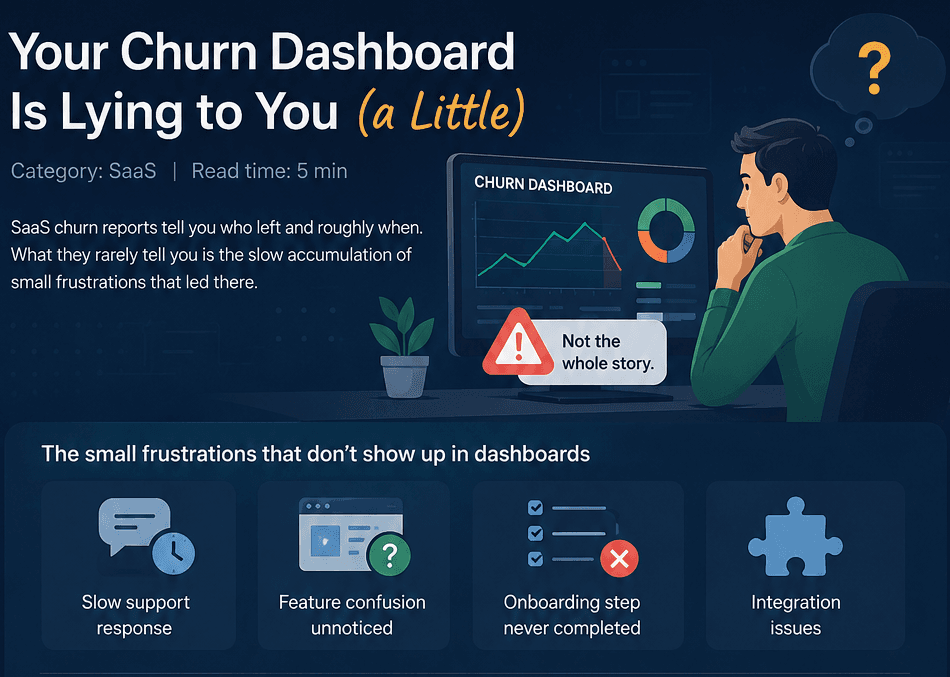
Your Churn Dashboard Is Lying to You (a Little)
SaaS churn reports tell you who left and roughly when. What they rarely tell you is the slow accumulation of small frustrations that led there — the support ticket that took too long, the feature confusion nobody flagged, the onboarding step that quietly never got completed.
Product velocity creates a support gap
SaaS products move fast — new features, frequent updates, constant iteration. That's a strength for growth and a liability for support, because every release is a new thing customers might get confused by, and a new thing your support team needs to actually understand before a ticket comes in, not after.
Why generic support doesn't scale with SaaS
Support for a SaaS product isn't just answering questions — it's explaining workflows, troubleshooting integrations, and sometimes telling the difference between a bug and a misunderstanding. That requires a team that's trained continuously, in step with your product, not onboarded once and left to catch up on their own.
What SaaS support needs to match the product's pace
- Tight feedback loops between support and product teams, so common confusion becomes a roadmap input, not just a ticket count
- Tiered technical depth, so simple "how do I" questions and complex integration issues both get resolved efficiently
- Proactive engagement with users who show early signs of disengagement, before it becomes a churn statistic
- Documentation that evolves as fast as the product does
Support as a retention lever, not a cost center
In a category where switching costs are often low and competitors are one search away, the quality of support becomes a genuine differentiator — sometimes more than the feature list itself. Customers stay with products that make them feel supported through change, not just sold to once.
Growth can be a great problem to have
As long as you have the right team.