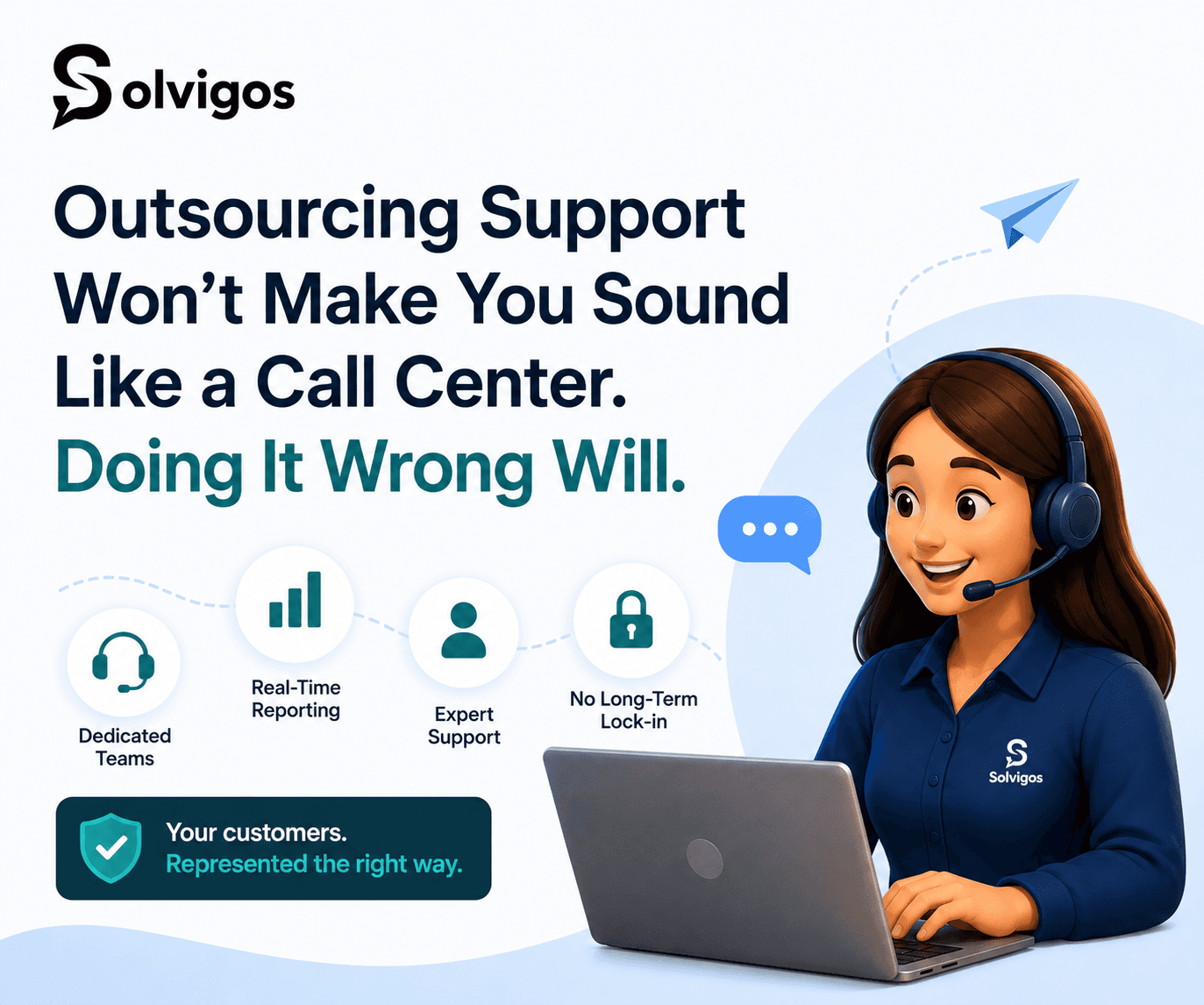
Outsourcing Support Won't Make You Sound Like a Call Center. Doing It Wrong Will.
Ask a founder why they haven't outsourced customer support yet, and you'll usually hear some version of the same three fears: it'll sound robotic, we'll lose control, and customers will notice. Those fears aren't irrational — they're based on real, bad experiences with the wrong kind of outsourcing. But they're also the reason a lot of growing businesses keep doing support badly themselves, long after it stops making sense.
Myth 1: "Outsourced support always sounds generic"
This used to be true when outsourcing meant handing your customers to a shared pool of agents juggling ten other brands at once, working off a script written by nobody who'd ever used your product. That model still exists, and it still sounds exactly the way people expect. But it's not the only model.
A dedicated team — agents assigned only to your account, trained specifically on your product, tone, and edge cases — doesn't sound outsourced at all. It sounds like the person who's been there since day one, because functionally, that's what they become. The difference isn't "in-house vs. outsourced." It's "dedicated vs. shared."
Myth 2: "We'll lose visibility into what's happening"
This fear usually comes from a bad experience with a vendor who treated reporting as an afterthought. In practice, a well-run outsourced team should give you more visibility than most in-house setups, not less — because reporting is built into the process from day one instead of assembled manually by someone too busy to do it consistently.
Response times, CSAT, first contact resolution, ticket volume trends, escalation patterns — this data should be sitting in front of you on a regular cadence, not something you have to ask for. If a partner can't show you this by default, that's a sign of the partner, not the model.
Myth 3: "It's cheaper, so it must be lower quality"
Cost savings and quality aren't actually in tension here — they come from different places. The savings come from not having to recruit, train, manage, and retain an internal team, not from cutting corners on the people answering your customers. A dedicated outsourced agent can be just as skilled, just as brand-trained, and just as accountable as an internal hire — often more consistently, because quality assurance is a core part of the service, not something squeezed in between other priorities.
Myth 4: "Our product is too complex to hand off"
Every founder believes this about their own product, and it's usually true for about the first two weeks of a proper onboarding process. Complexity isn't a reason to avoid outsourcing — it's a reason to be selective about who you outsource to. A partner that runs real onboarding (deep product training, simulated tickets, structured ramp-up before going live) can handle complexity that a rushed, script-only setup never could.
What actually determines whether outsourcing works
- Dedicated teams over shared pools — your agents should know your business, not eleven others
- Structured onboarding, not a login and a PDF
- Regular, proactive reporting, not data you have to chase down
- No long-term lock-in, so the arrangement has to keep earning its place
- A real escalation path, so the moments that need a human touch always get one
The real risk isn't outsourcing. It's outsourcing carelessly.
The businesses that get burned by outsourcing almost always got burned by the same thing: a generic vendor, a shared team, and a "set it and forget it" handoff. That's not what a good support partnership looks like — and conflating the two costs founders years of doing support themselves that could have been handled better, faster, and for less.
How Solvigos does it differently
At Solvigos, every client gets a dedicated support team — not a shared pool — trained specifically on your product, tone, and processes before a single ticket goes live. Onboarding is structured across three phases (Discover & Align, Build & Launch, Optimize & Scale), so nothing goes live until it's ready. You get real-time reporting on response times, CSAT, and resolution rates without having to ask for it, a dedicated account manager as your single point of contact, and no long-term lock-in — because we believe the partnership should earn its place every month, not just at signing.
Whether you need customer support, technical support, back-office operations, or CRM and AI chatbot setup, the model is the same: your business, represented properly, without the overhead of building it in-house.
Thinking about outsourcing but not sure who to trust with it? Talk to our team about what a dedicated, done-right support partnership actually looks like.
Growth can be a great problem to have
As long as you have the right team.